
















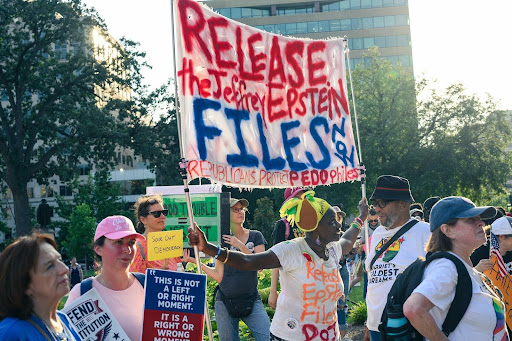







On Feb. 6, 2026 at 1:30 p.m., hundreds of students at L.C. Anderson High School left campus with the intent of protesting against Immigration and Customs Enforcement (ICE), a federal law enforcement organization whose “militarization of the border” has “produced rampant abuses ranging from racial profiling to excessive force”, according to the American Civil Liberties Union.
As students gathered in front of the school, they focused their attention on Salomé Casey, one of the organizers of the walkout, who kicked off the protest with a speech where she outlined the purpose of the event. “Today is about supporting each other,” she said. “We fight for our families, fight for our friends, we fight for our teachers and for our staff.”
Shortly after Casey’s initial speech, Lola Selberg, another organizer, emphasized the importance of coming out to protest. “Change doesn’t always happen in voting booths or in the news, it happens in classrooms, at dinner tables and in moments just like this one. You do not need to be an expert, you do not need to have the perfect words, you just need to reject indifference.” Selberg directly addressed Texas Governor Greg Abbott in her speech, proclaiming, “If my old friend Greg Abbott is somehow listening to this, I hope you know that while it is admirable that you are upholding the responsibility of Texas schools to educate our kids, we are doing the exact same.”
In recent times, Governor Abbott has been attempting to quell ICE protests from occurring at Texas schools by threatening to cut funding from districts who allowed students to go off campus to protest. Abbott has stated that students “have a job” and that is “to go be in a classroom”, citing this as a reason for his stance against protests during school hours.
Following Casey and Selberg’s speeches, Lucy Laves, another organizer of the protest, expressed how proud she was to have helped organize the protest and how proud she was of the students who decided to march. “You all showed up here today because you understand the importance of not staying silent. You cannot turn a blind eye to injustice. Thank you for using your voices.”
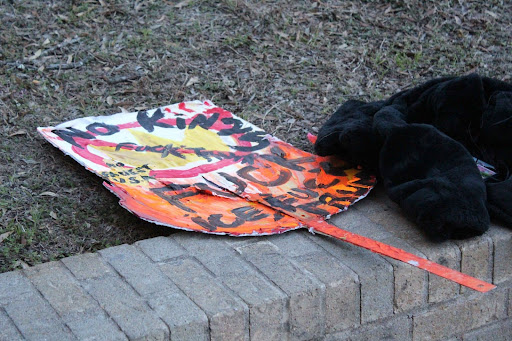
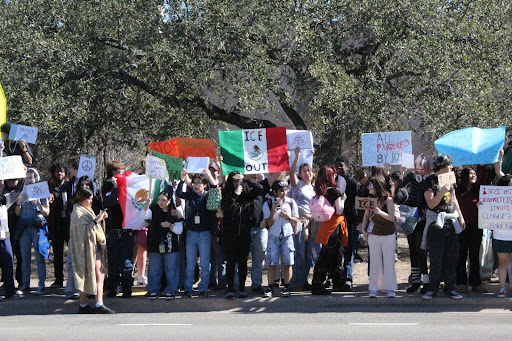
After the initial speeches from Casey, Selberg, and Laves concluded, the march began. Students headed south on Mesa Drive, east on Steck Avenue, turned north at the Hillcrest Church, passed Hill Elementary School, and then moved westward back to Anderson. As students marched on the sidewalk, with police cars following closely behind, they held up signs, chanted, and played music. The protest gained more traction as cars driving past the march honked in solidarity, and parents and residents living near the route of the protest cheered as the march passed them. Once the march was over, students regrouped at the front circle where they could get bottled water and stop by a bench that held voter registration forms, paper, and envelopes addressed to local representatives and Texas senators that could be used to voice complaints. This regrouping marked the beginning of a second wave of speeches.
To honor the people who’d lost their lives to ICE, Laves encouraged the protesters to say their names, a form of tribute that was used during the Black Lives Matters movement in order to bring attention to the lives lost due to injustice. “As we stand here together, it is imperative that we remember why we are marching. We must honor the lives lost because of the wreckless, inhumane actions of ICE and the Department of Homeland Security. Say their names: Silvero Villegas Gonzales, Isaias Sanchez Barboza, Geraldo Lunas Campos, Victor Manuel Diaz, Parady Law, Alex Pretti, Renee Good, Luis Beltran Yanez Cruz, Herber Sanchez Dominguez, Luis Gustavo Nunez Caceres, Keith Porter. We say their names because they do deserve to be remembered, they do not deserve to be gone.”
One anonymous student shared their perspective on the situation as an immigrant in their speech, stating, “On Feb. 7 2024, I was approved to enter the land of freedom, and in July 2025, I was given a piece of paper that said I am now a US citizen, protected by the constitution, the same piece of paper in which in this administration’s eyes, you are either a human or an alien. But sadly, nowadays, having this paper doesn’t mean s—. Renee Good, a mother, Alex Pretti, a respected nurse, were both shot and denied medical attention despite having the special piece of paper. This has never been about criminals, this is a targeted attack against people of color and people who dare speak out.”
Later, when asked for further comments, the student mentioned that, as an immigrant, it’s “important to speak out”, especially during major events. “Our own government is planning to kill our people and take them off the streets, so despite me fearing for my immigration status, and of course I have to cover my face, it’s very important to show out and show them that we’re not afraid.”
Saaya Accapadi, Austin’s Youth Poet Laureate of 2025, recited a poem she wrote that was dedicated to Liam Ramos, a five year old boy who, along with his father, “was detained by immigration officers in Minnesota and held at an ICE facility in Texas.”
“I imagine a pair of innocent eyes mirroring the clouded sky above. After all, no child wants to be torn from their family and from their homes. I remember a time, when I was seven in the grocery store, tears hurling in my little eyes, lost and terrified. Within moments I was embraced by warm eyes, warm arms, and kind eyes. And the United States in the 2026 calendar year, when they see a child, lost and alone, they see brown skin before brown eyes. They see illegal and scream exterminate. The country, our parents, our grandparents, we dreamed of is not the one we live in. A melding pot stirred by love, obliterated and knocked down, freezing on the cold, hard ice. When my mind goes to Liam Ramos, I imagine the warm sunshine enveloping him, hugging him, in the way his mother cannot. A big blue knit hat over a small, small head. When I imagined this country when I was young, I saw 50 stars, 13 stripes, Ople’s Apple Pie. What would Liam Ramos see?”
Once the second wave of speeches concluded, the protest did as well. According to an email sent out by Principal Brian Lancaster shortly after the march concluded, “approximately 500 students left their classes” to attend the protest that day, which not only indicated the number of students who attended, but the number of passionate students who felt the need to speak up about the injustices communities have faced at the hands of ICE.