

























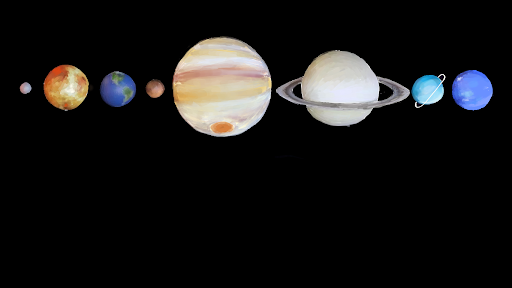
On Saturday, Feb. 28, 2026, a rare astronomical event called the planetary parade will occur, featuring six planets aligning in a visible formation. Usually, planetary parades see four or five planets align with each other, but this year, the planet count is six. Dr. Jeffrey “Moe” Moehlenbruck”, Anderson’s astronomy teacher, gave good insight into this topic.
According to Dr. Moe, planetary parades occur because all of the planets orbit around the sun in roughly the same flat plane, known as the ecliptic plane. Each planet travels at a different speed and distance, but several of them can appear to line up from our planet’s view at certain times. Despite the appearance of them aligning perfectly, the effect is purely visual since all the planets are millions, if not billions, of kilometers away from each other.
Rare events like this usually only happen every few years or even decades. The latest parade happened back in August 2025 including Mercury, Venus, Mars, Jupiter, Saturn, Uranus, and Neptune, a staggering seven planets. So unfortunately, although this year’s planetary parade doesn’t seem as amazing compared to last year’s, it still provides an opportunity for astronomy fans to see planets with their own eyes.
Because planets move slowly, viewing opportunities for this year’s planetary parade can last for weeks, but February 28 is expected to be when they appear most tightly clustered. Mercury, Venus, Mars, and Jupiter, should be visible without any equipment. However, Uranus and Neptune are much farther away and usually require binoculars or a telescope to spot clearly. Mercury can also sometimes be harder to see since it stays low near the horizon.
Dr. Moe explained that watching from Austin specifically can affect visibility. “You might be able to see Mercury and Venus,” he stated. “Saturn if you’ve got a good eye.”
Overall, this alignment offers an exciting chance for people to observe multiple planets at once. The best time to see the planetary parade is in the evening of February 28 shortly after sunset, when the sky becomes dark enough for the planets to stand out. Clear weather and good timing will make it easier to spot more planets in the sky. Choosing a location away from city lights is also important since light pollution can make dimmer planets harder to see.
“If you have a telescope and you plan ahead, go to a place where there’s not a lot of light pollution and see how many planets you can see,” Dr. Moe advises. He also recommended the UT McDonald Observatory in Alpine, Texas as an especially great viewing spot.
Overall, with preparation, dark skies, and the right equipment, viewers will have a great chance to enjoy the planetary parade.